How to Digitize Grandma's Handwritten Recipes (Without Losing the Stories)
Photograph the cards, OCR + AI-parse the text, and crucially — capture the stories in the notes field. 60 seconds per card.
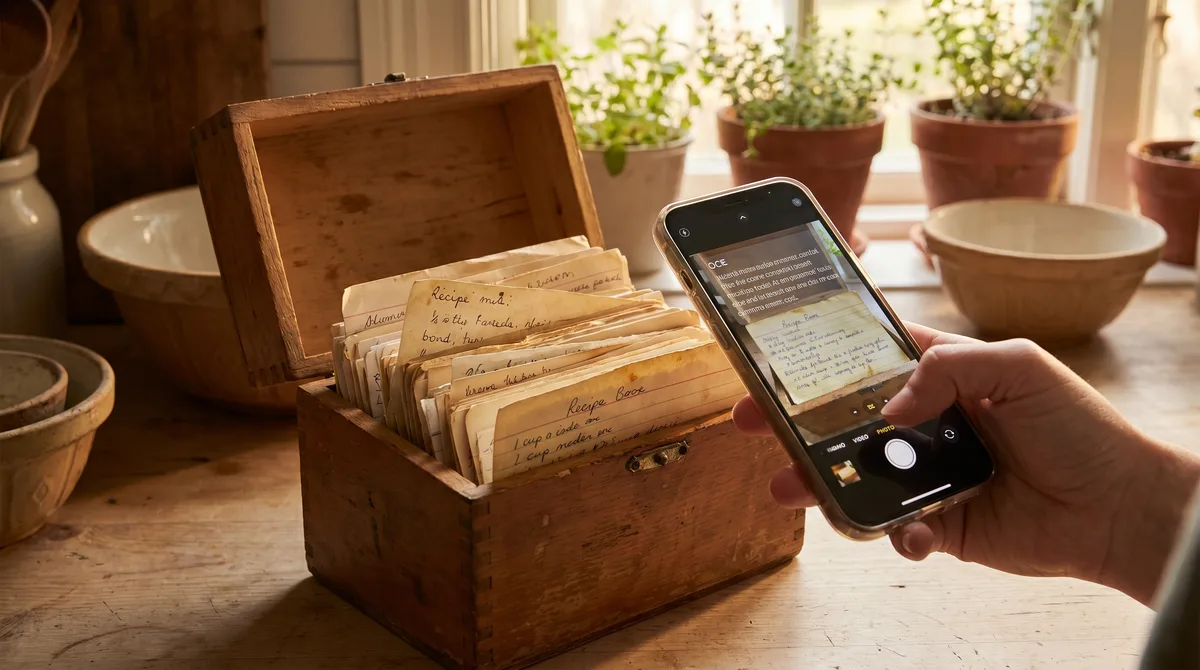
There's a stack of handwritten recipe cards somewhere in your family. Some are yours, some your mother's, some your grandmother's. Most are stained from being used. A few are written in a hand you don't quite recognize but in a script you remember. They're irreplaceable, and almost everyone who owns them has been meaning to digitize them for years and hasn't.
This is the workflow that gets it done in one evening, without losing the stories.
The materials
- Your stack of handwritten recipe cards or pages.
- Your phone.
- Decent light — daylight near a window is ideal; bright lamp light works.
- About 60 seconds per card.
The workflow per card
- Lay the card flat under good light. Avoid casting your phone's shadow on the card.
- Open Forktastic → + → Import from Photo.
- Take the photo, hold the phone parallel to the card. The OCR is more forgiving than you'd think, but a square-on photo improves results.
- Forktastic's OCR reads the text and the AI parser structures it into a recipe — title, ingredients, steps.
- Review for OCR errors. Handwriting OCR is good but not perfect. Names of obscure ingredients ("schmaltz," "graham flour") are sometimes misread. Quick edit.
- Add the story — this is the part most people skip and regret later. Use the recipe's notes field for the context that doesn't fit anywhere else: "Grandma made this every Christmas Eve until 1998. The trick is to brown the butter for longer than you think." Save.
For multi-page recipes
Take 2-3 photos of each page. Forktastic's batch photo import stitches them into a single recipe. Verify after import that nothing got merged out of order.
For recipes with photos on the card
If the card has a small photo of the dish, photograph the whole card and Forktastic preserves the image alongside the recipe. Useful for visual reference; doesn't have to be a great photo.
The story field is the point
Recipe cards have ingredients and steps. They also have memory — who made it, when, why, the trick that's not in the steps. That's the part that gets lost if you only digitize the recipe itself. Use the notes field aggressively. Future-you and future-family will thank you.
Organize into a Family cookbook
Create a cookbook called something like "Grandma's Kitchen" or "Family Heirloom Recipes" and import all the cards into it. Keeps them separate from web-sourced recipes. When the time comes to gift the family cookbook as a hardback PDF, this cookbook is your starting point.
If the handwriting is illegible
Some cards have handwriting only a particular family member can read. Sit with that person, photograph the card, then dictate or type the recipe directly into Forktastic while they translate. This is also the right moment to capture the story for the notes field — they're already remembering.
Where to go next
For the PDF cookbook gift workflow, family cookbook PDF guide. For broader import methods, import pillar. For Family Sharing so other family members get access, family setup.